
Q4 2026
Amplifying the Signal
Most companies put real money into thought leadership. Then the piece goes live, gets one post from the brand page and a handful of reshares, and that’s it.
Most companies put real money into thought leadership. They pay for research, writers, SME interviews, executive insights, design, and legal review. Then the piece goes live, gets one post from the brand page and a handful of reshares, and that’s it. Fade to black.
Sometimes the content deserves to crash and burn. It’s just bad. But we find that, most of the time, the real is distribution. The plan—if there is one at all—ends at publish.
We wanted to show what happens when great content gets the distribution it deserves, so we used our own work as a test case.
The piece
This fall, Gather Partner Kirsten Chen published “Intellectual Sovereignty in the Era of AI Enshittification” on The Dispatch. Borrowing Cory Doctorow’s term for the way some tech companies intentionally degrade their platforms to wring more money out of users, Kirsten argued that AI tools are drifting down that very same path—while also, in some ways, enshittifying us, their users.
She issued a challenge to leaders. In your organization, who is actually deciding what gets done: your people or your tools?
It is long, opinionated, and demanding. Conventional wisdom says a 2,000-word argument like this is dead on arrival in most social feeds.
We promoted the essay alongside an episode of The Gather Signal, our podcast, putting a small, deliberate amount of paid support behind it on LinkedIn: $812 in total.
What $812 bought
The flight delivered 128,511 impressions and 7,396 engagements, at roughly 11 cents per engagement. The core campaign ran a 10.4% engagement rate, against a published benchmark of 2 to 5% for LinkedIn sponsored content. Impressions cost $6.32 per thousand, where $10 to $20 is typical.
On LinkedIn itself, we brought readers to the article for about $1.15 per visit. Published averages for a US click on LinkedIn run $8 to $10.
Reach only matters if it’s the right reach. Where LinkedIn reports seniority, three in four impressions went to people at Senior level or above, and 38% went to Directors, VPs, partners, owners and C-suite. The audience included people at Microsoft, Google, AWS, IBM, Accenture, EY and JPMorganChase.
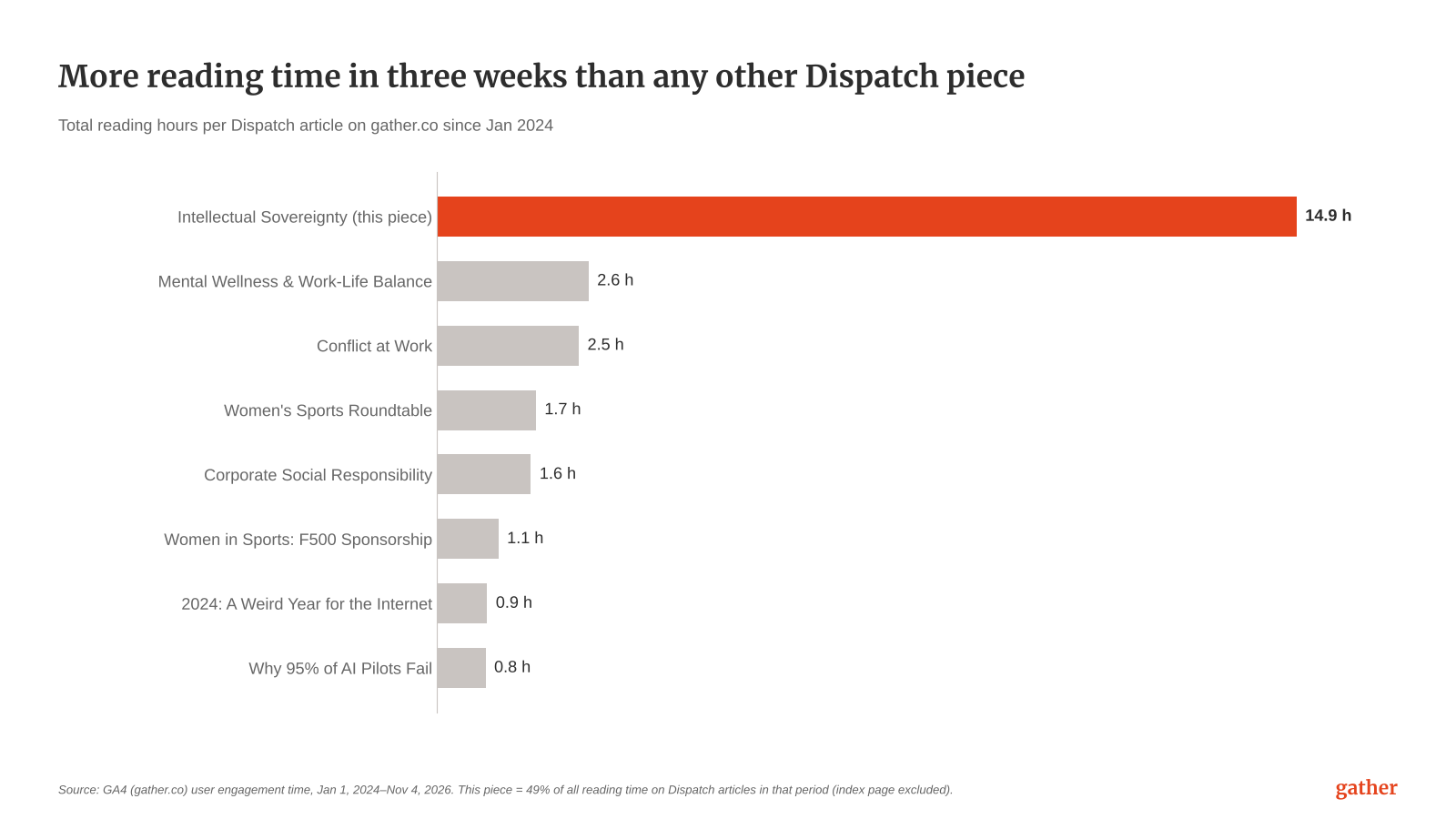
And they read it. The essay has logged 14.9 hours of reading time, almost all of it during the three-week flight. That’s nearly half of all the time anyone has spent reading Dispatch articles since January 2024, and 5.7 times our previous best. Traffic to gather.co ran at 2.9x the three weeks before.
Not every click is worth it
Nearly two-thirds of the paid clicks to the article came through LinkedIn’s Audience Network, its placements on third-party apps and sites. The traffic tied to those placements stayed for about three seconds. Readers who arrived from LinkedIn itself averaged over a minute each, and the small group who came through colleagues’ posts averaged more than two.
This isn’t a failure. It’s data we would never have gotten if we hadn’t put money on the table. If we had relied solely on organic, praying that the algorithm gods would smile upon us, we’d know comparatively little about our readers, and which ones were worth pursuing further.
Precise targeting makes precise reporting possible, and precise reporting tells you exactly where the next dollar shouldn’t go. Now we know where not to do placements, which means we can get even more bang for our 812 bucks next time.
Don’t set your content up to fail
When it comes to content, distribution is half the work. Budget for it. If a piece is worth weeks of production, it’s worth a deliberate plan to reach the people it was written for. Look what just a few hundred dollars of well-aimed support did here.
People are your best channels. The longest reads came from people who found the piece through someone they know. Which makes sense: We’re all way more likely to trust a recommendation from a friend or colleague over a faceless corp. Your company is full of experts with their own networks. Get them to share and talk about your content.
Aim at a person, not an audience size. It’s always better to reach the right thousand readers than the wrong hundred thousand. Cheap impressions get expensive quickly when you’re targeting people who were never going to convert.
Measure attention, not clicks. Reading time, seniority of readers, and what people do next tell you whether content worked. Click counts are often just vanity metrics.
Why this matters now
Brand pages are having a harder and harder time earning organic reach now that so many people browse the internet through AI chat windows. Meanwhile, their social feeds are crammed to the brim with thoroughly competent, totally forgettable, wholly AI-generated content.
For your content to cut through, you need two things: a real viewpoint, and a plan to reach the people who need to hear it. These are two disciplines—making great content and maximizing reach—that we practice every day with our clients.
Do you have work that deserves more readers? Let’s talk.